Bathroom Storage Ideas Without Cabinets: 8 Ways to Add Useful Space
No bathroom cabinets? Create practical storage with freestanding shelves, carts, door storage, wall accessories, baskets, and smarter use of the space around your sink.
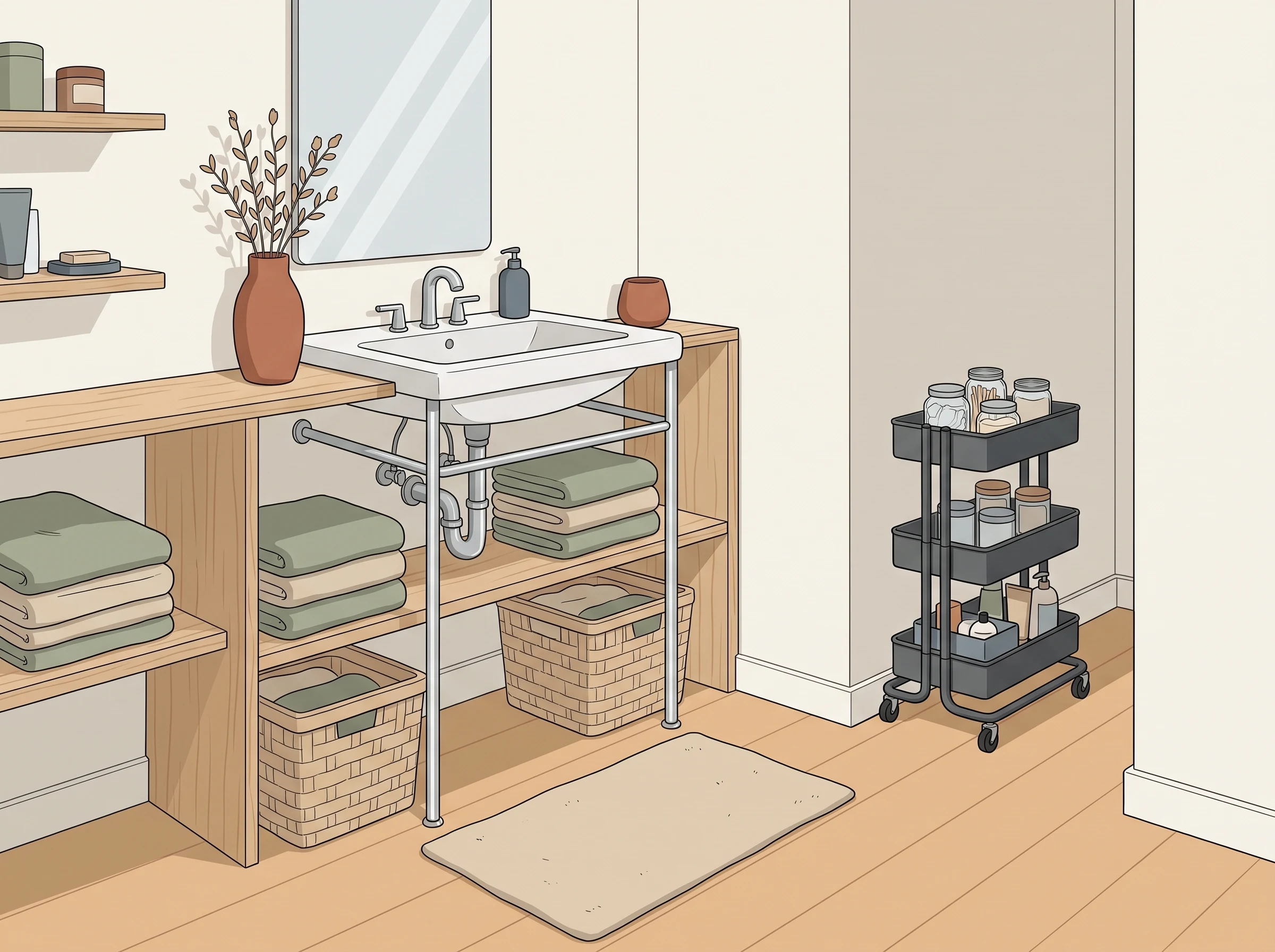
A bathroom without cabinets can make even a modest number of toiletries feel like clutter.
But you do not necessarily need a built-in vanity to create useful storage.
The key is to replace the functions a cabinet normally performs:
- everyday access,
- concealed storage,
- vertical organization,
- towel storage, and
- backup-supply storage.
Current IKEA small-bathroom guidance recommends several of these same approaches, including freestanding shelving around the sink, carts, hooks, door storage, and removable wall accessories.
Here is how to build a simple system.
1. Start With the Space Under the Sink
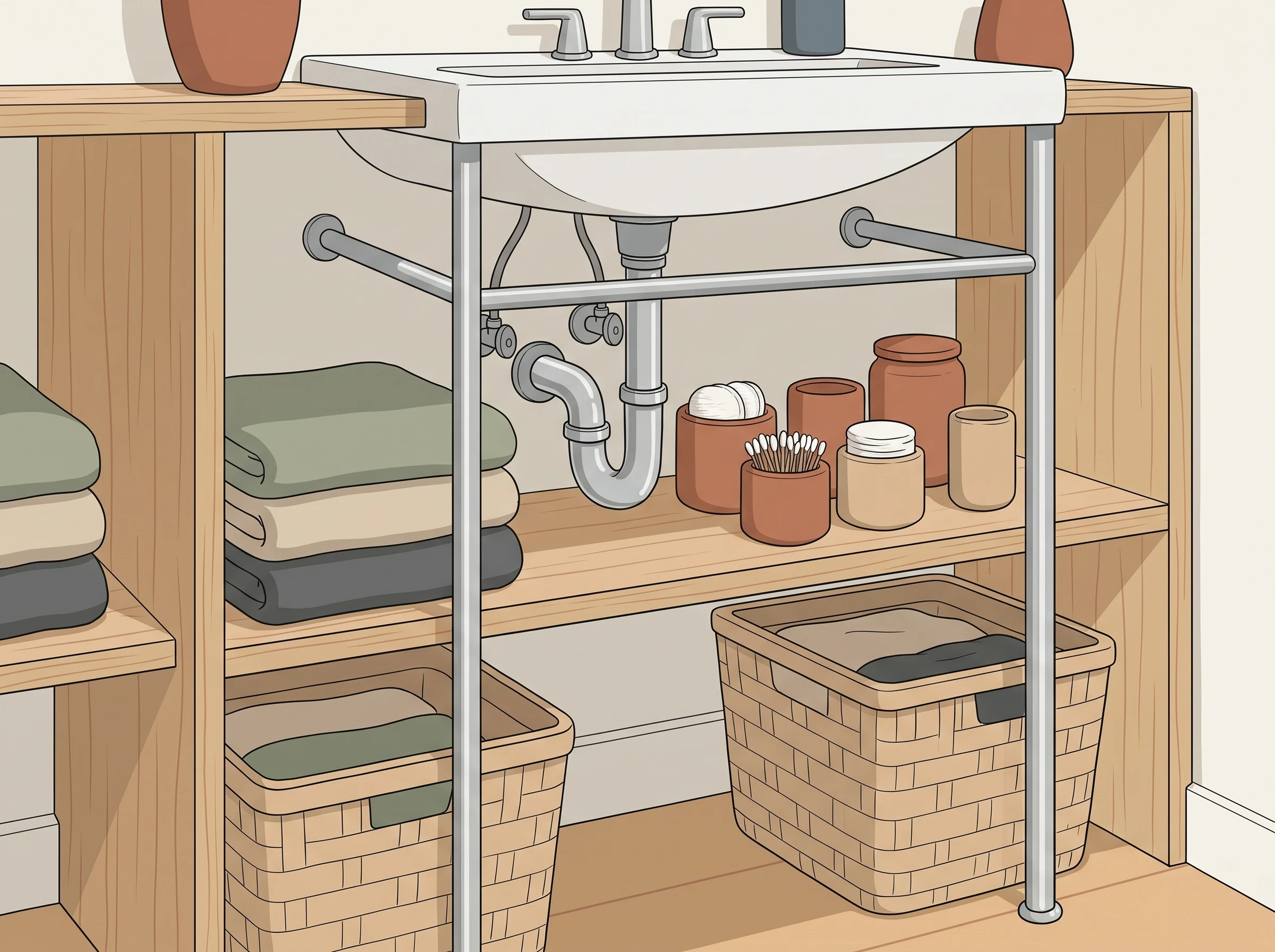
A pedestal or wall-mounted sink often leaves a large volume underneath unused.
Freestanding shelves can turn that space into storage without replacing the sink itself. IKEA specifically recommends freestanding shelving as a quick way to create storage in bathrooms without built-in vanity drawers.
Store here
Good candidates include:
- extra toilet paper,
- cleaning supplies,
- folded towels,
- backup toiletries, and
- baskets of personal-care items.
Measure carefully
Plumbing makes this space irregular.
Measure:
- width,
- depth,
- pipe position,
- pipe height, and
- usable clearance.
Product slot
Freestanding under-sink shelving unit
Why it may fit: Uses otherwise wasted volume around plumbing.
Consider: Verify that the actual shelf geometry accommodates your sink pipes.
2. Add a Slim Rolling Cart
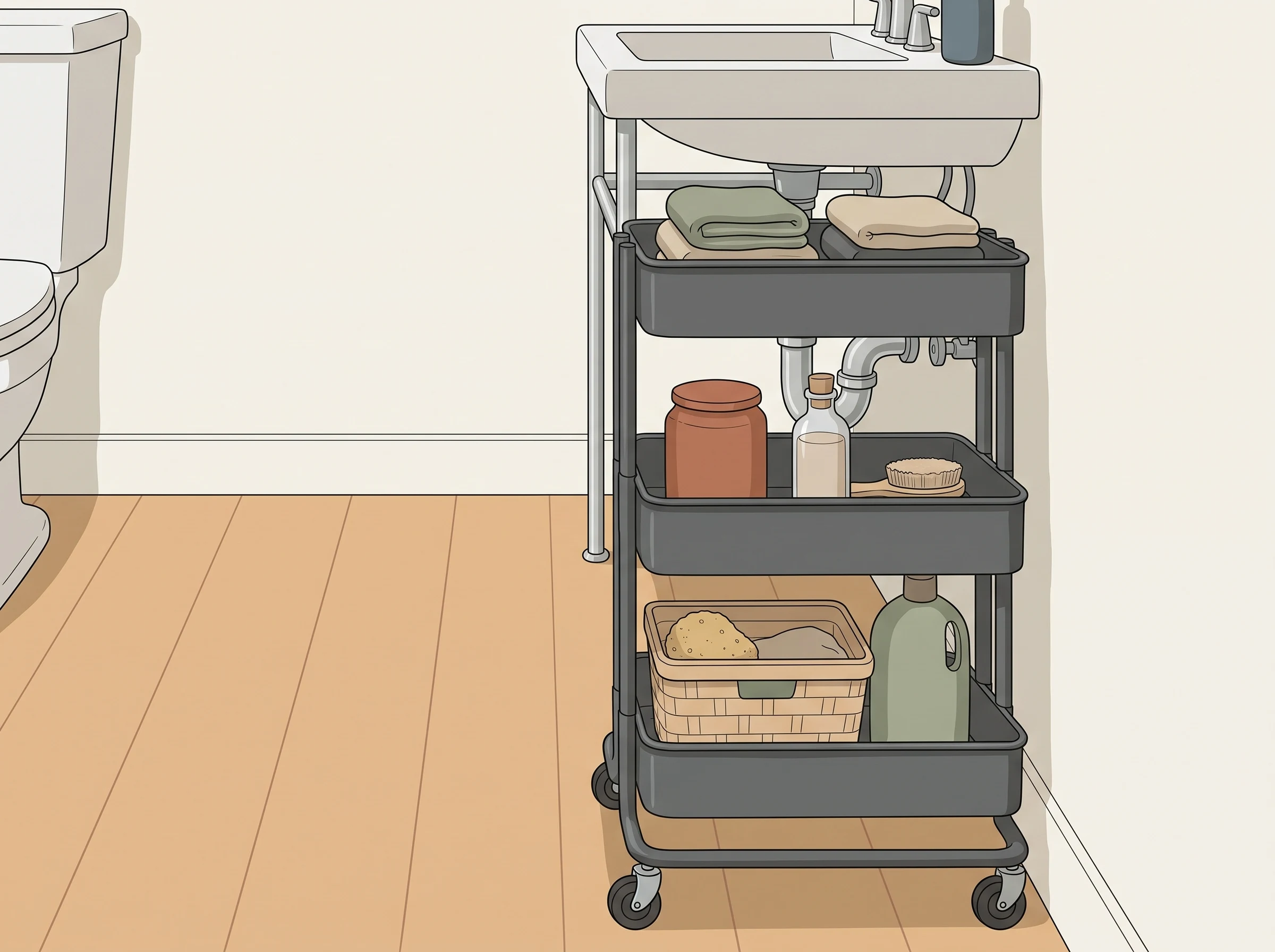
A cart creates movable storage without requiring built-in cabinetry.
IKEA’s current renter-bathroom guidance includes carts and small freestanding shelf units among flexible ways to organize bathrooms.
A narrow cart can hold:
- daily toiletries,
- towels,
- hair products,
- cleaning supplies, and
- backup products.
Product slot
Slim bathroom rolling cart
Best for: Bathrooms with a narrow open strip beside the sink or toilet.
Consider: Measure both width and depth. A cart that projects too far into the room can make a small bathroom harder to move through.
3. Use the Bathroom Door
The back of the door can provide useful vertical storage.
IKEA’s small-bathroom guidance specifically shows door-mounted hooks combined with baskets and hanging containers as a way to customize storage without consuming floor area.
Possible uses include:
- towels,
- robes,
- lightweight baskets,
- hair tools after they have cooled and where appropriate, and
- small accessories.
Product slot
Over-the-door bathroom organizer or hook system
Measure:
- door thickness,
- top clearance,
- organizer depth, and
- door swing.
Make sure the door remains easy to operate.
4. Use Removable Wall Storage for Everyday Items
Wall storage can keep counters clear without adding furniture.
Current IKEA bathroom guidance specifically recommends suction-cup hooks, mini shelves, and containers as no-drill ways to keep frequently used items accessible.
Potential uses include:
- toothbrushes,
- soap,
- shower products,
- small grooming items, and
- hand towels.
Product slot
Suction or removable wall-storage system
Best for: Small everyday items that otherwise crowd the sink.
Consider: Surface compatibility matters. Follow the product’s installation instructions and use it only on surfaces specified by the manufacturer.
5. Use Corners Instead of Filling the Center of the Room
Bathroom corners often remain unused because conventional rectangular furniture does not fit them efficiently.
A compact corner shelf can provide multiple levels of storage without taking over the center of the room.
IKEA’s current renter-bathroom examples include freestanding corner shelf units as flexible storage around sinks and other awkward areas.
Product slot
Compact bathroom corner shelf
Good for:
- rolled towels,
- toiletries,
- baskets, and
- backup products.
Tradeoff
Open corner shelving looks best when each shelf has a defined purpose.
Without categories, it can quickly become a vertical pile of bottles.
6. Give Small Items Containers of Their Own
Bathrooms contain many objects that are individually small:
- cotton swabs,
- razors,
- hair accessories,
- cosmetics, and
- grooming tools.
When these objects share one open shelf, the room can still look cluttered even if everything technically has a place.
Use:
- small bins,
- baskets,
- trays, and
- transparent organizers.
IKEA’s current bathroom-organization guidance recommends smaller boxes and organizers for subdividing bathroom storage so that individual items remain easier to find.
Product slot
Small bathroom organizer/bin set
This does not need to be an expensive recommendation.
Its purpose is category control.
7. Separate Daily Products From Backup Products
One reason bathroom counters become crowded is that active and backup products occupy the same storage.
Create two zones.
Daily
Keep close to the sink or shower:
- toothbrush,
- skincare used daily,
- soap, and
- frequently used grooming products.
Backup
Store elsewhere:
- unopened shampoo,
- extra soap,
- spare toilet paper, and
- extra towels.
The daily zone should be compact.
The backup zone can occupy less convenient storage.
This simple distinction reduces the amount of storage that needs to remain immediately accessible.
8. Use Closed Containers to Reduce Visual Clutter
If every bathroom item remains visible, adding more shelves can make the room feel more crowded rather than more organized.
Use baskets, opaque bins, or other closed containers for visually irregular categories.
A practical balance is:
OPEN

daily-use products

+

CLOSED

backup supplies
miscellaneous items
extra toiletries
The goal is not to hide everything.
It is to control what remains visible.
Build a Bathroom Without Cabinets by Function
A simple system might look like:
UNDER SINK
backup supplies

ROLLING CART
daily toiletries

DOOR
towels and robes

WALL
small frequently used items

CORNER SHELF
secondary storage

BINS
small loose objects
You do not need every solution.
Choose only the ones that solve actual storage gaps.
What to Measure
| Area | Measure |
|---|---|
| Under sink | width, depth, plumbing |
| Rolling-cart space | width, depth, walkway |
| Door | thickness, top clearance, swing |
| Corner | usable width/depth |
| Wall accessory area | available surface and manufacturer-compatible mounting surface |
Measure first.
Shop second.
Product Opportunities for This Guide
A lean affiliate version can use one selected product for each of these roles:
- Under-sink freestanding shelf
- Slim rolling cart
- Over-door organizer
- Removable wall organizer
- Corner shelf
- Small organizer/bin set
You may ultimately need only four or five.
If a recommendation does not add genuine value, leave the section informational.
The Bottom Line
A bathroom without built-in cabinets does not have to become a bathroom without organization.
Replace the functions of a cabinet one at a time:
- create a zone around the sink,
- add movable storage,
- use doors and walls,
- keep small items contained, and
- separate daily products from backups.
The result can be more flexible than a single large cabinet—and easier to adapt if you eventually move.
Relevant options
Product considerations
These are practical product types to evaluate against your measurements and installation limits.
Adjustable under-sink shelf
Adjustable under-sink shelf
May work well for:Comparing options for no cabinets
- Useful when
- No cabinets
- Consider
- Confirm plumbing clearance material and assembly dimensions
Potential benefits
- Relevant product category
- Retailer destination available
Slim rolling cart
Slim rolling cart
May work well for:Comparing options for no cabinets
- Useful when
- No cabinets
- Consider
- Confirm wheel clearance and bathroom moisture suitability
Potential benefits
- Relevant product category
- Retailer destination available
Over-door bathroom organizer
Over-door bathroom organizer
May work well for:Comparing options for no cabinets
- Useful when
- No cabinets
- Consider
- Confirm door thickness top clearance and door swing
Potential benefits
- Relevant product category
- Retailer destination available
Compact countertop caddy
Compact countertop caddy
May work well for:Comparing options for no cabinets
- Useful when
- No cabinets
- Consider
- Confirm counter footprint and splash exposure
Potential benefits
- Relevant product category
- Retailer destination available