Compact Home Office Organization: Make a Small Workspace Work Better
Organize a compact home office with a narrow desk, vertical storage, cable control, desktop organization, and flexible solutions that fit into small rooms and apartments.
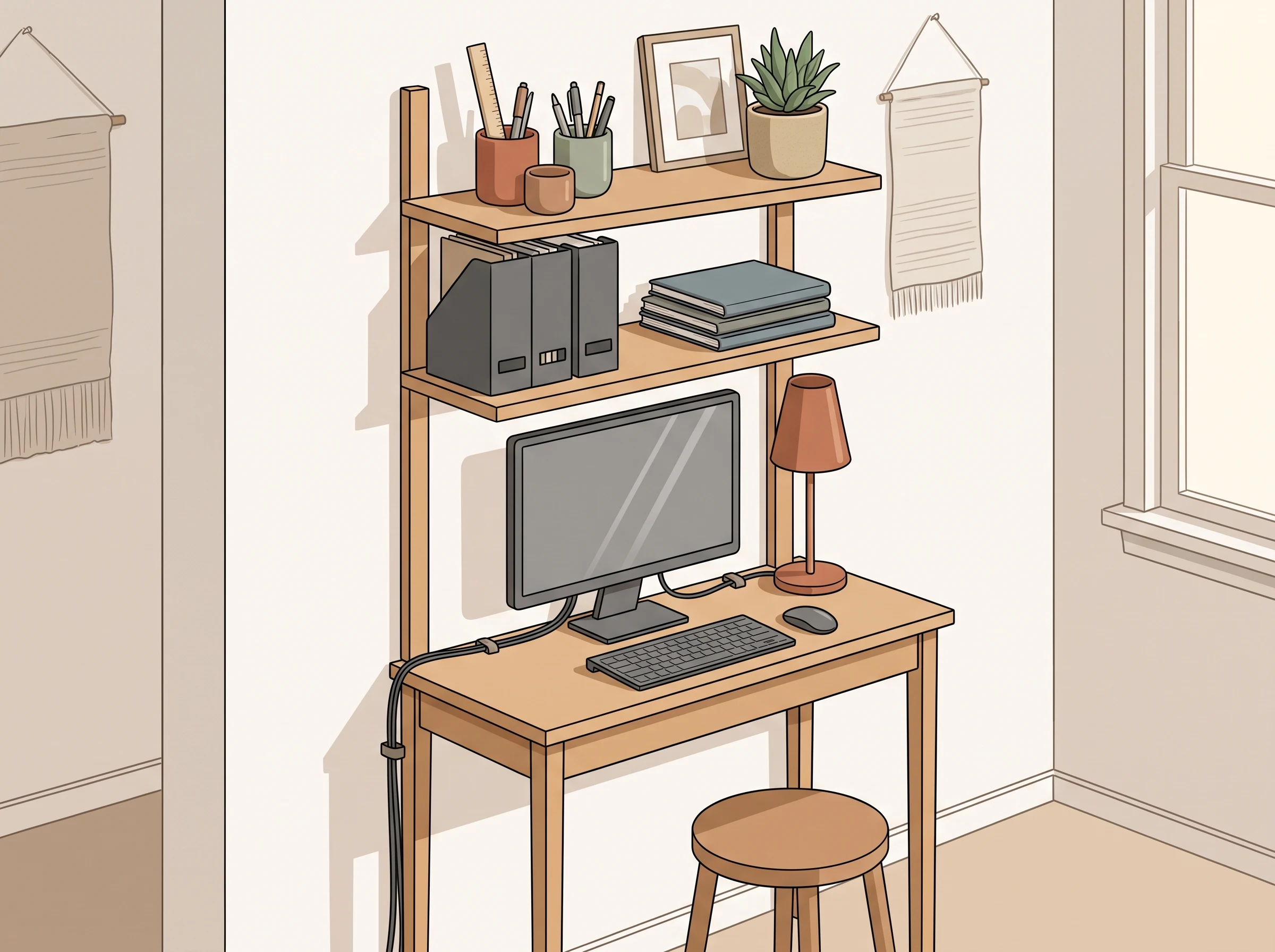
A home office does not necessarily need its own room.
It needs a defined place where work can begin without requiring you to rebuild the setup every morning.
For many apartments and small homes, that might be:
- part of a bedroom,
- a hallway,
- one end of the living room,
- a wall beside a closet, or
- an unused nook.
Current IKEA small-workspace guidance similarly shows compact desks, wall storage, memo boards, narrow work surfaces, and tucked-away chairs being used to turn overlooked areas into functional work zones.
The challenge is to make the office compact without making it cramped.
1. Start With the Smallest Desk That Supports the Work
Do not begin by shopping for the largest desk that fits the wall.
Begin with the work.
Ask:
- laptop only?
- monitor?
- keyboard and mouse?
- notebooks?
- scientific or creative equipment?
- paperwork?
- video meetings?
Then determine the minimum useful surface.
IKEA’s current compact-workspace guidance specifically emphasizes narrow desks and compact work surfaces when a dedicated office room is unavailable.
Product slot
Compact/narrow desk
Research criteria
Record:
- width,
- depth,
- height,
- storage,
- leg clearance, and
- cable access.
Important
Desk depth matters as much as width.
A narrow desk that projects too far into a bedroom can obstruct circulation.
2. Use the Wall Above the Desk
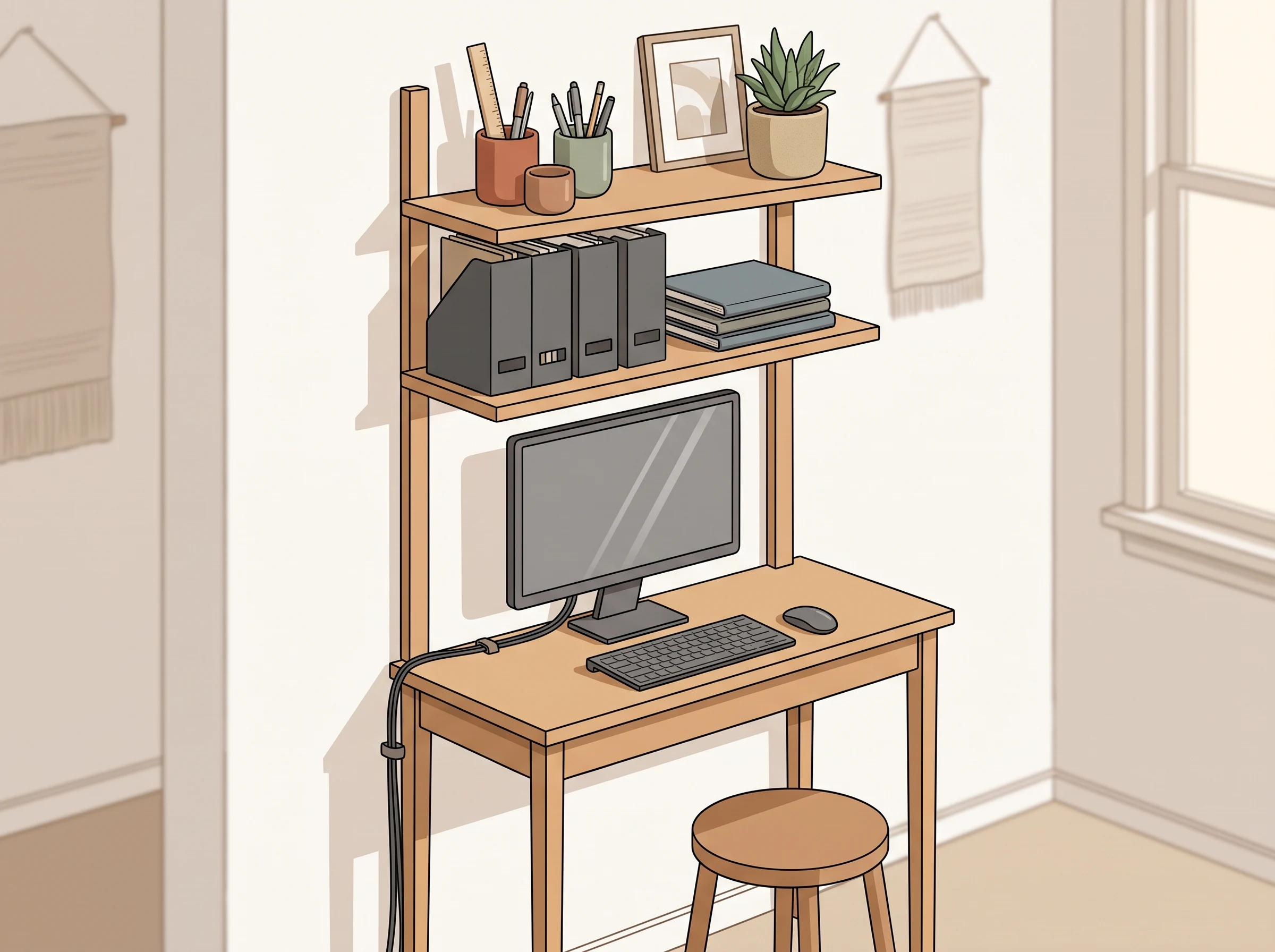
When the desk is small, horizontal surface area should be reserved primarily for working.
Move secondary storage upward where appropriate.
Possible uses:
- shelves,
- memo boards,
- document holders, and
- lightweight office accessories.
IKEA’s small-home workspace examples use wall shelving and memo boards above compact desks specifically to increase functionality without expanding the desk footprint.
Product slot
Desk wall organizer / memo board
For renters, installation method needs to be evaluated separately.
Do not call a wall product renter-friendly without checking how it attaches.
3. Create a Second Level on the Desk
A desktop shelf or monitor riser can use vertical space without requiring a wider desk.
It may provide room for:
- monitor,
- small notebooks,
- keyboard storage,
- accessories, and
- charging equipment.
Current IKEA guidance for small home offices recommends compact desktop organizers and shelves to make better use of limited desk area.
Product slot
Desktop shelf / monitor riser
Best for
A desk with adequate width but limited usable surface area.
Consider
Check:
- monitor dimensions,
- ergonomic positioning,
- shelf depth,
- stability, and
- clearance underneath.
Do not compromise comfortable monitor placement simply to gain storage.
4. Give Small Desk Items Defined Categories
A compact desk becomes crowded quickly because small objects accumulate:
- pens,
- cables,
- adapters,
- sticky notes,
- memory cards,
- scissors, and
- chargers.
Use a small organizer rather than multiple independent containers.
IKEA’s current small-office guidance specifically highlights compartment organizers and small boxes for reducing desktop clutter.
Product slot
Compartment desk organizer
Assign categories such as:
Writing
Charging
Paper
Small electronics
The organizer should contain the category, not encourage you to keep every small object within reach.
5. Treat Cable Management as Storage
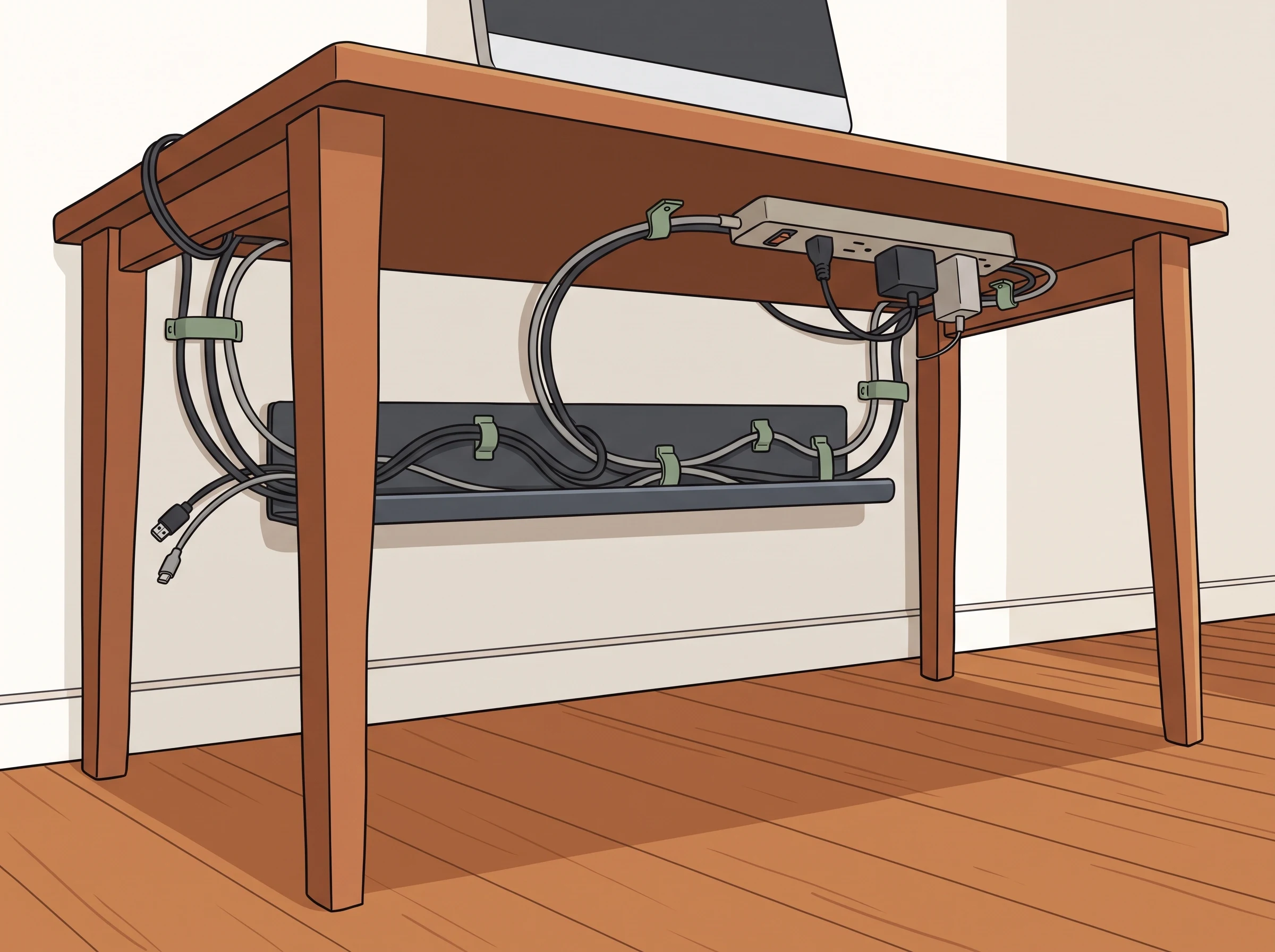
Cables consume surprisingly little physical volume but create a large amount of visual clutter.
Common problems include:
- charger cables hanging from the desk,
- power strips on the floor,
- excess cable length, and
- multiple adapters.
Current IKEA home-office guidance specifically calls out cable management as part of keeping a compact workspace uncluttered.
Product slot
Cable-management tray or box
Possible approaches:
- under-desk tray,
- cable box,
- clips, and
- reusable ties.
Best for
Workspaces with several permanently connected devices.
Consider
Maintain ventilation and follow the manufacturer’s instructions for electrical equipment.
6. Put Paperwork in Vertical Storage
Stacks of paper expand horizontally.
Instead, assign active paperwork a vertical system.
Possible formats:
- upright file holders,
- wall files, and
- desktop magazine files.
Product slot
Vertical file organizer
Use it for current material only.
Archive or discard completed paperwork elsewhere.
A small workspace should not become long-term document storage unless that is actually required.
7. Use a Rolling Drawer Unit When the Desk Has No Storage
A minimalist desk can provide an excellent work surface but nowhere to put supplies.
Instead of buying a larger desk, consider separate movable storage.
Product slot
Compact rolling drawer unit
Advantages:
- can move,
- can sit under or beside a desk,
- separates work surface from storage, and
- may adapt to future rooms.
Tradeoff
Measure legroom carefully.
Storage underneath a desk is not helpful if it makes sitting uncomfortable.
8. Keep the Chair From Becoming Storage
In compact bedrooms and living spaces, the office chair often becomes a place for:
- clothing,
- bags,
- papers, and
- headphones.
Then the workspace is effectively unavailable until it is cleared.
Give those categories another home.
IKEA’s small-workspace guidance suggests wall hooks and designated bag storage as simple ways to keep portable work items ready without occupying the work surface.
Product slot
Simple hook / bag-storage solution
This may remain a non-commercial suggestion if no product recommendation adds meaningful value.
9. Create a Shutdown Routine
A compact office often shares a room with another activity.
That makes visual separation important.
At the end of the workday:
Close laptop
↓
Return stationery
↓
File active papers
↓
Coil/store loose cables
↓
Move work bag
↓
Clear desk
The goal is to transform:
office inside bedroom
back into:
bedroom with a compact workspace.
This becomes especially important when the desk is visible from the bed or living area.
10. Consider Furniture That Can Change Function
If even a permanent compact desk occupies too much space, look at furniture that changes configuration.
Current IKEA small-workspace guidance includes foldable work surfaces and storage units that provide a workstation only when needed.
Possible concepts include:
- folding desk,
- wall-mounted fold-down surface where installation is appropriate,
- storage unit with integrated work surface, and
- console-sized desk.
Product slot
Compact folding desk
Best for
Occasional laptop work rather than setups with several permanent monitors.
Consider
A folding desk only saves space if the operator actually folds it away.
Build the Workspace in Layers
Think of the compact office vertically:
ABOVE DESK
shelves / memo board

DESKTOP
computer + immediate tools

UNDER DESK
cables / drawer unit

SIDE
bag / files / overflow
The desk itself does not need to contain everything.
What Deserves Desk Space?
Usually yes
- computer,
- input devices,
- frequently used notebook,
- one writing tool, and
- immediate task materials.
Usually not
- archives,
- unopened mail,
- backup cables,
- rarely used accessories, and
- unrelated household objects.
The smaller the desk, the more valuable each square inch becomes.
Compact Office Product Opportunities
For the first affiliate version, research:
- Compact desk
- Desktop shelf / monitor riser
- Compartment organizer
- Cable-management solution
- Vertical file organizer
- Rolling drawer unit
- Optional folding desk
Not every section needs a product.
A five-product article may be cleaner than a seven-product one.
A Quick Decision Guide
| Problem | First solution |
|---|---|
| Desk too large for room | Narrow desk |
| Desk surface crowded | Desktop shelf |
| Small items everywhere | Compartment organizer |
| Cable clutter | Cable tray / box |
| Paper stacks | Vertical file holder |
| No drawers | Rolling drawer unit |
| Workspace only needed occasionally | Folding desk |
The Bottom Line
A compact home office works best when the desk is treated as workspace, not as the storage location for every work-related object.
Choose the smallest desk that supports the actual task.
Use height for secondary storage, contain small items, move cables out of sight, store papers vertically, and keep overflow separate from the work surface.
A small office should take up less room—not make work harder.
Relevant options
Product considerations
These are practical product types to evaluate against your measurements and installation limits.
Monitor riser with storage
Monitor riser with storage
May work well for:Comparing options for limited workspace
- Useful when
- Limited workspace
- Consider
- Confirm desk width depth monitor weight and viewing height
Potential benefits
- Relevant product category
- Retailer destination available
Vertical file organizer
Vertical file organizer
May work well for:Comparing options for limited workspace
- Useful when
- Limited workspace
- Consider
- Confirm desk footprint paper size and stable base
Potential benefits
- Relevant product category
- Retailer destination available
Cable-management tray
Cable-management tray
May work well for:Comparing options for limited workspace
- Useful when
- Limited workspace
- Consider
- Confirm desk material clamp range and cable capacity
Potential benefits
- Relevant product category
- Retailer destination available
Slim rolling drawer unit
Slim rolling drawer unit
May work well for:Comparing options for limited workspace
- Useful when
- Limited workspace
- Consider
- Confirm desk clearance drawer dimensions and wheel path
Potential benefits
- Relevant product category
- Retailer destination available