Under-Bed Storage Ideas for Small Bedrooms: Use the Space Without Creating a Mess
Turn unused space beneath your bed into practical storage for clothing, shoes, bedding, and seasonal items with a system that stays easy to access.
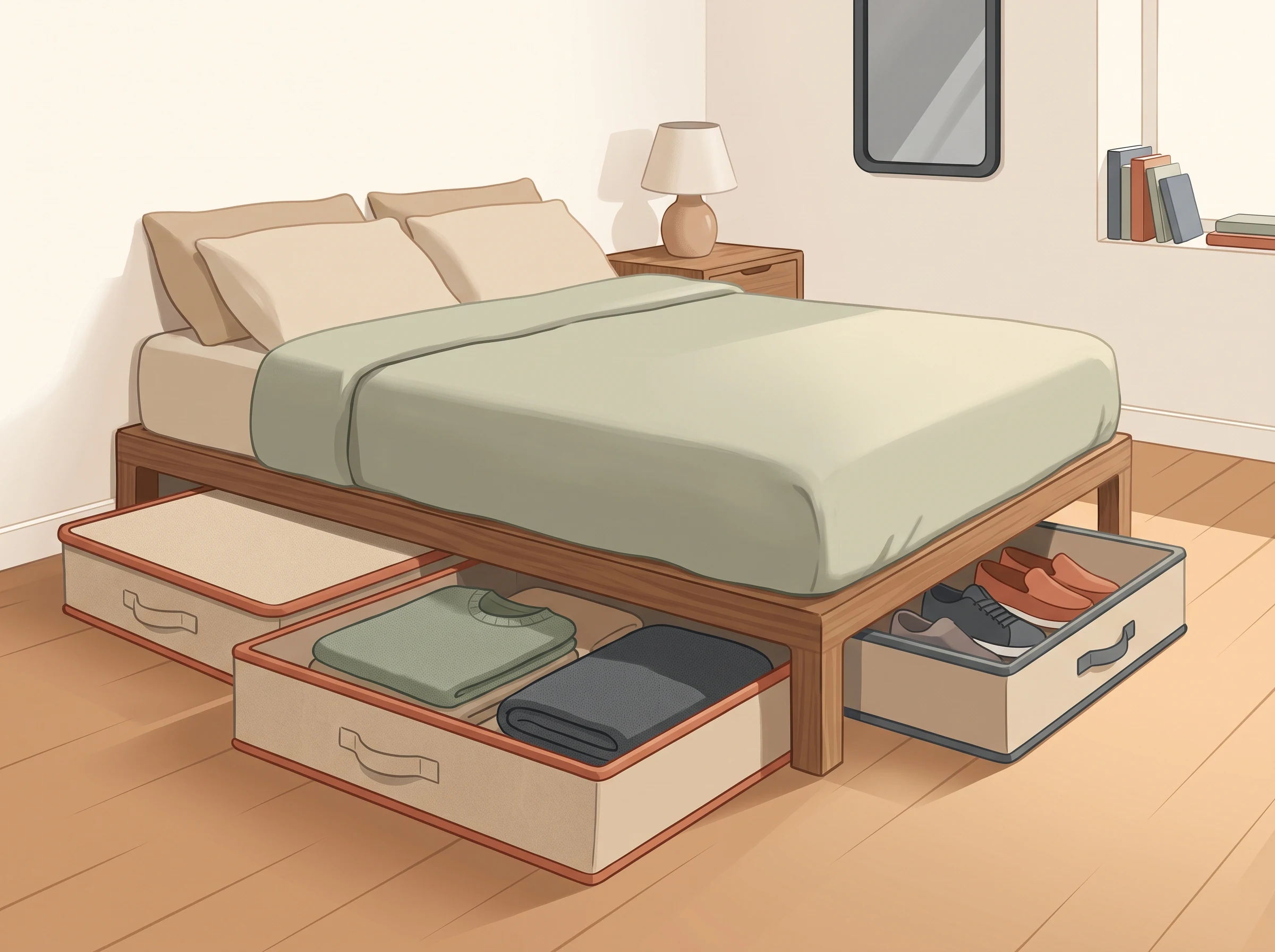
In a small bedroom, the bed already occupies a large percentage of the floor.
That makes the empty volume underneath it unusually valuable.
Under-bed storage is a long-established small-bedroom strategy, and current IKEA small-space guidance continues to recommend it for belongings you want nearby but do not necessarily need every day. IKEA also specifically recommends keeping under-bed containers reasonably lightweight so they remain easy to pull out.
The trick is not simply putting things under the bed.
It is creating a system you can still use six months later.
1. Measure the Clearance Before Choosing Storage
Start with the lowest vertical clearance beneath the bed.
Measure from:
floor → lowest part of the bed frame
rather than:
floor → top of the side rail.
Also measure:
- usable width,
- usable length,
- center supports,
- legs,
- nearby furniture, and
- the amount of room available to pull a container out.
A container that technically fits underneath but cannot be removed without moving the nightstand is not very useful.
Product slot
Low-profile under-bed storage container
Look for a product whose verified external height leaves reasonable clearance rather than one that barely squeezes underneath.
2. Give the Easiest-Access Space to the Things You Use Most
Not every part of the area under the bed is equally accessible.
The front and sides are usually easier to reach than the center.
Use the easiest areas for things you access relatively often, such as:
- shoes,
- workout clothing,
- extra towels, and
- bags.
Use harder-to-reach areas for:
- seasonal clothes,
- spare bedding, and
- rarely used accessories.
Think of the space under the bed as a tiny storage room with a front and a back.
Do not make yourself crawl underneath every morning for socks.
3. Choose Rolling Storage When Access Matters
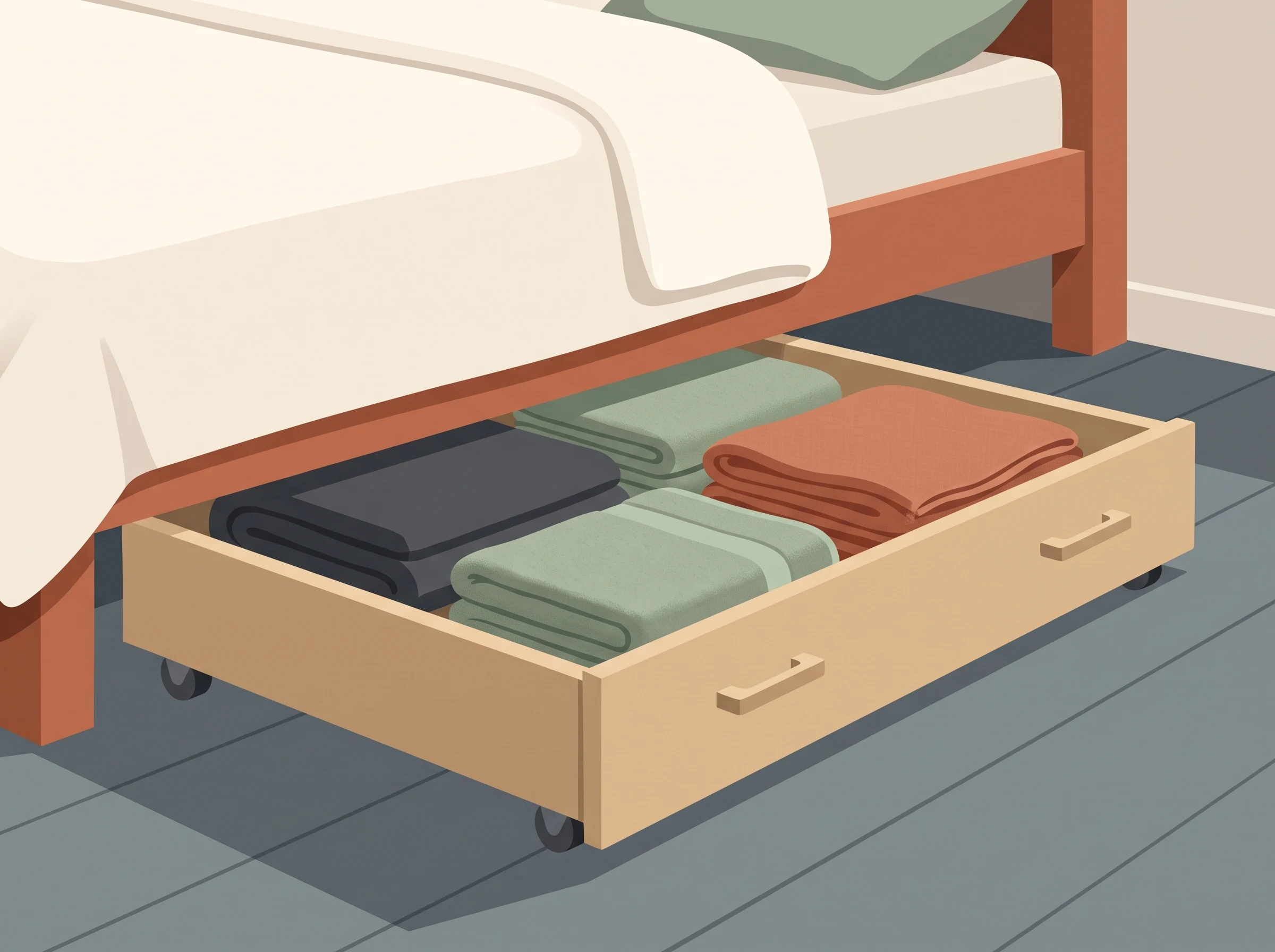
Wheels can make a container significantly easier to retrieve, particularly on hard floors.
A rolling container may work well when the stored items are accessed regularly.
Useful situations include:
- shoes,
- handbags,
- folded clothing, and
- hobby supplies.
Product slot
Rolling under-bed storage
Why it may fit: Useful when the container needs to come out frequently.
Consider: Wheels add height, so check the complete external height before buying.
4. Choose Covered Storage for Textiles
Seasonal clothing and spare bedding usually benefit from storage that keeps them contained rather than sitting openly under the bed.
Possible formats include:
- rigid containers with lids,
- zippered fabric cases, and
- enclosed drawers.
IKEA’s current bedroom organization guidance explicitly points to under-bed storage for spare pillows and off-season clothing as a way to keep bedroom clutter out of sight while retaining access.
Product slot
Covered fabric or rigid storage case
Best for: Bedding and seasonal clothing.
Consider: Soft-sided containers can be easier to fit into irregular spaces, while rigid containers may hold their shape better. Verify the actual construction of any product you select.
5. Divide the Space by Category
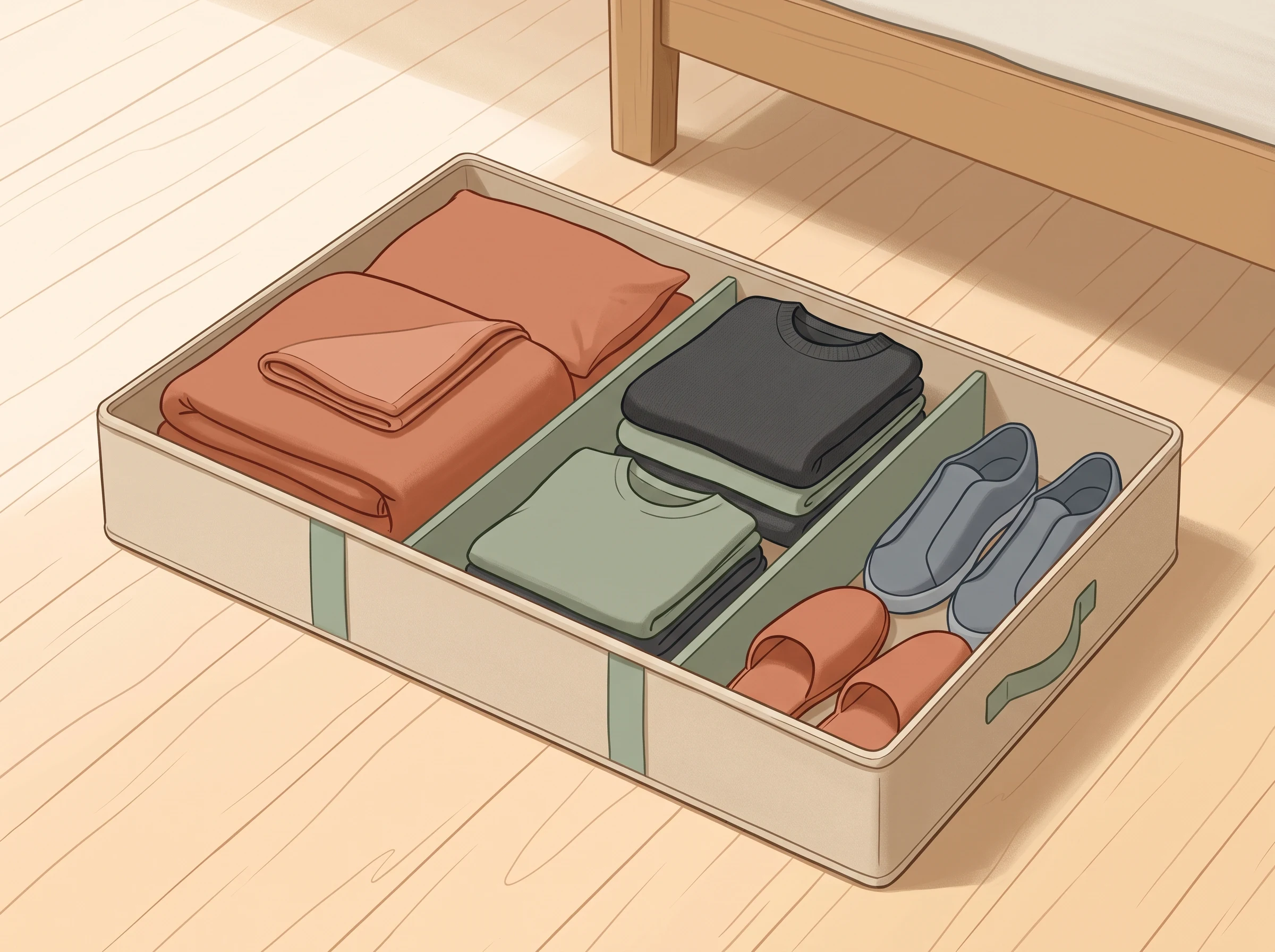
Avoid creating one giant container labeled:
Miscellaneous
Instead, give each container one job.
For example:
WINTER CLOTHES

EXTRA BEDDING

SHOES

TRAVEL BAGS
The purpose of storage is not simply to hide objects.
It should make them easier to find.
If one container contains six unrelated categories, under-bed storage can quickly turn into a place where belongings disappear.
6. Use Under-Bed Shoe Storage Only If Shoes Are the Real Problem
Shoes have an awkward combination of volume and irregular shape.
If they are consuming closet or floor space, a dedicated under-bed shoe organizer can make sense.
Product slot
Under-bed shoe organizer
Look for:
- realistic compartment dimensions,
- easy access, and
- a format appropriate to the types of shoes you actually own.
Do not choose an organizer simply because it advertises a large shoe count.
Boots, athletic shoes, flats, and children’s shoes occupy very different amounts of space.
7. Consider Dual-Purpose Under-Bed Furniture
Some small-space furniture combines under-bed storage with another function.
IKEA currently highlights pull-out under-bed units that can serve as storage and temporary bedside surfaces, illustrating how one volume can perform more than one job in a small room.
This can be useful when floor space is extremely limited.
Product slot
Pull-out under-bed storage / bedside unit
Best for: Rooms where even a permanent nightstand uses too much floor area.
Consider: Make sure the unit has enough clearance to pull out completely and does not interfere with normal movement around the bed.
8. Don’t Pack Containers So Heavily That They Become Permanent
Under-bed storage works only if you can retrieve it.
IKEA’s current guidance specifically recommends lightweight storage cases and cautions against packing them so heavily that they become difficult to move.
A container filled with dense books may fit perfectly but become frustrating to use.
Instead, reserve under-bed storage primarily for lighter bulky items such as:
- bedding,
- clothing,
- shoes, and
- bags.
Rigid Bin or Fabric Bag?
Neither is automatically better.
| Type | Often useful for | Main consideration |
|---|---|---|
| Rigid bin | Shoes, accessories, structured organization | External height and lid clearance |
| Fabric case | Bedding and seasonal clothing | Shape and ease of pulling |
| Rolling drawer | Frequently accessed items | Wheel height and floor clearance |
| Divided shoe case | Shoes | Compartment dimensions |
| Pull-out furniture | Storage + bedside function | Required pull-out space |
Choose according to the problem rather than the appearance.
What Should Go Under the Bed?
Good candidates
- seasonal clothing,
- spare bedding,
- occasional shoes,
- travel bags,
- extra towels, and
- low-frequency accessories.
Less convenient candidates
- daily medication,
- everyday clothing,
- chargers used nightly, and
- frequently needed paperwork.
Prime storage locations should go to frequently used belongings.
Under-bed space is more valuable as secondary storage.
A Simple Under-Bed Storage Plan
Before buying anything:
Step 1
Measure the complete usable space.
Step 2
List the belongings you want to move there.
Step 3
Group them by category.
Step 4
Determine how frequently each category is used.
Step 5
Choose the appropriate container style.
Step 6
Leave enough room to remove the container comfortably.
Step 7
Label the container if its contents are not visible.
Product Opportunities for This Guide
For a lean affiliate version, this article needs only a few carefully chosen products:
- Low-profile general storage container
- Rolling under-bed container
- Covered textile-storage case
- Optional shoe organizer
- Optional dual-purpose pull-out unit
One product per slot is enough.
Do not turn the guide into a catalog.
The Bottom Line
The space under your bed can provide a surprising amount of storage without adding another piece of furniture to the room.
But the most successful system is not the one that fits the largest number of objects.
It is the one that stays easy to use.
Measure first, assign each container a category, keep frequently used items near the easiest access points, and reserve the deepest storage for things you need less often.
That turns the area under your bed from a hiding place into part of the room’s actual storage system.
Relevant options
Product considerations
These are practical product types to evaluate against your measurements and installation limits.
Low-profile general storage bin
Low-profile general storage bin
May work well for:Comparing options for limited floor space
- Useful when
- Limited floor space
- Consider
- Confirm exterior height including lid and wheel clearance
Potential benefits
- Relevant product category
- Retailer destination available
Rolling under-bed bin
Rolling under-bed bin
May work well for:Comparing options for limited floor space
- Useful when
- Limited floor space
- Consider
- Confirm exterior height wheel quality and pulling access
Potential benefits
- Relevant product category
- Retailer destination available
Covered textile storage case
Covered textile storage case
May work well for:Comparing options for limited floor space
- Useful when
- Limited floor space
- Consider
- Confirm soft-goods use zip quality and moisture protection
Potential benefits
- Relevant product category
- Retailer destination available
Under-bed shoe organizer
Under-bed shoe organizer
May work well for:Comparing options for limited floor space
- Useful when
- Limited floor space
- Consider
- Confirm shoe capacity and bed-frame clearance
Potential benefits
- Relevant product category
- Retailer destination available