Apartment Storage Ideas That Don't Require Drilling: 8 Flexible Options for Renters
Add storage to a rental apartment without drilling by using over-the-door organizers, freestanding shelves, rolling carts, under-bed storage, removable systems, and overlooked surfaces.
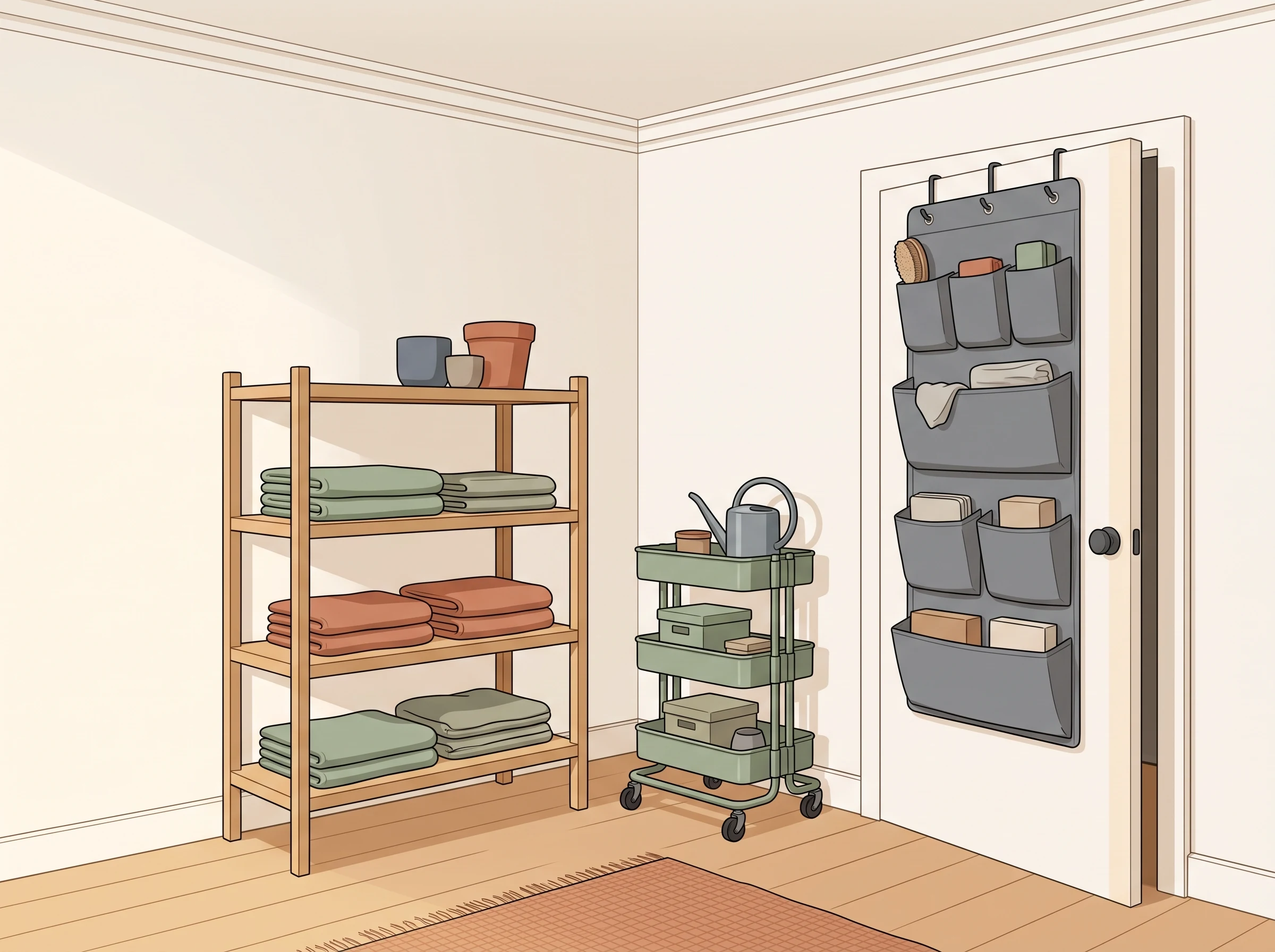
Renters often face two storage problems at the same time:
- the apartment does not have enough built-in storage, and
- modifying walls or cabinetry may be restricted.
Fortunately, adding storage does not always mean adding permanent shelving.
Freestanding furniture, over-the-door organizers, under-bed containers, rolling carts, and removable organizing systems can all add capacity without requiring conventional drilled installation. Renter-oriented organizing guidance commonly highlights adhesive/removable systems and other non-permanent approaches for exactly this reason.
The goal, however, is not to make everything no-drill.
It is to choose the least permanent solution that safely solves the problem.
1. Start With Furniture That Stands on Its Own
The simplest no-drill storage solution is often furniture that does not attach to a wall at all.
Possible examples include:
- low shelving,
- carts,
- small drawer units,
- benches with storage, and
- compact cabinets.
This can work especially well in apartments because the storage can move with you.
Product slot
Compact freestanding storage unit
What to research
Look for:
- overall width,
- depth,
- height,
- storage configuration,
- assembly requirements, and
- intended use.
Best for
Living rooms, bedrooms, home offices, or entryways where you need meaningful storage capacity.
Important safety note
“Freestanding” does not automatically mean “safe without anchoring.”
Some taller furniture, particularly clothing-storage units, may require anchoring or other stability measures. CPSC continues to issue recalls and warnings for unstable clothing-storage furniture, including products sold online in 2026. Follow the manufacturer’s instructions rather than skipping required anti-tip measures simply to avoid making a wall attachment.
2. Use the Back of a Door
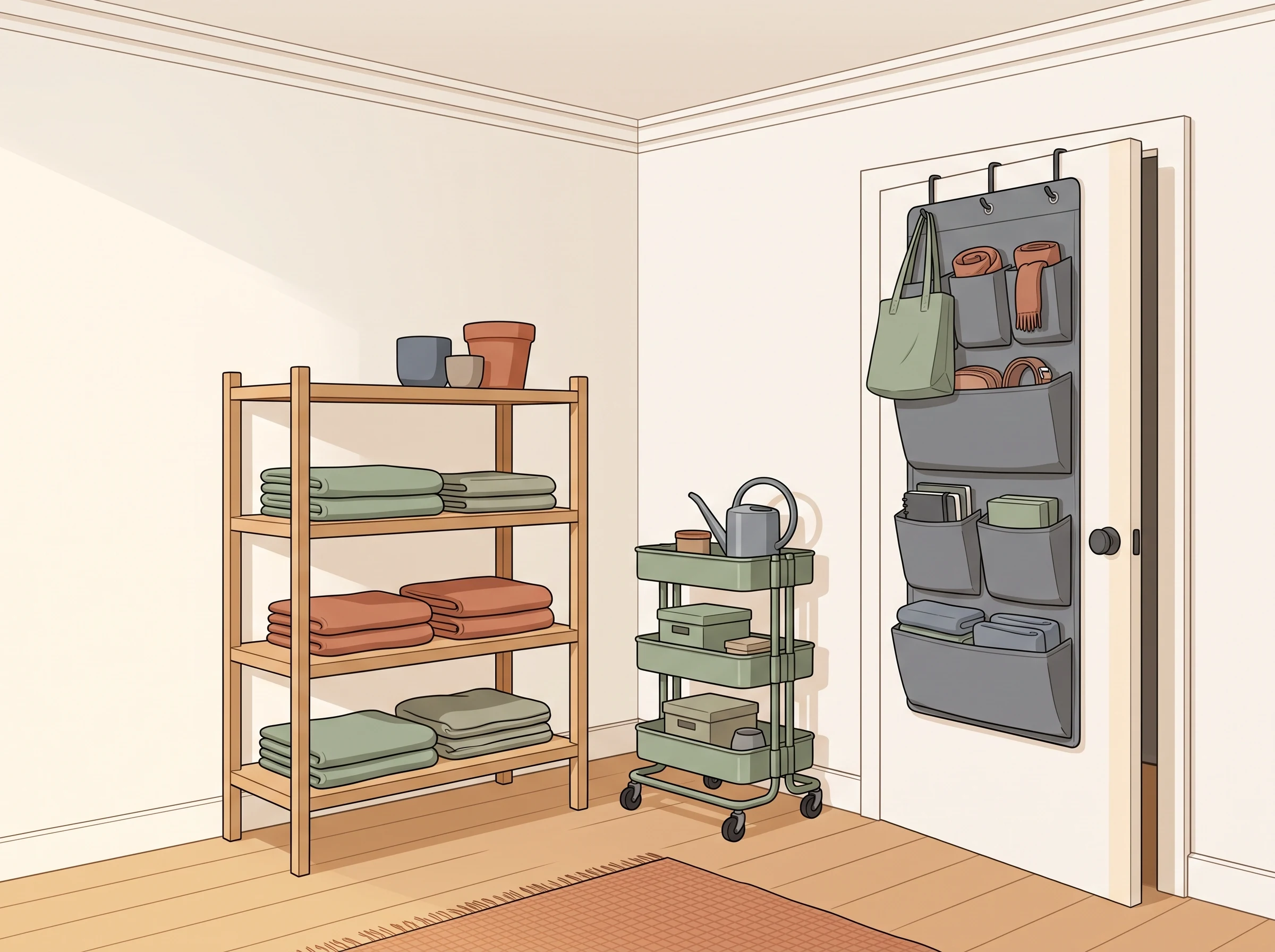
Doors provide vertical space without occupying additional floor area.
Possible storage includes:
- shoe organizers,
- hooks,
- pocket organizers,
- baskets, and
- accessory storage.
Over-the-door organizers are a common renter solution precisely because they can add vertical storage without conventional drilled shelving.
Product slot
Over-the-door organizer
Good for
- shoes,
- bags,
- cleaning supplies,
- scarves,
- accessories, and
- pantry items depending on the room.
Measure first
Check:
- door thickness,
- clearance above the door,
- organizer depth, and
- wall clearance when the door opens.
An organizer that prevents the door from closing is not useful storage.
3. Put Low-Frequency Items Under the Bed
The area beneath a bed can hold a surprising amount without affecting walking space.
Good candidates include:
- seasonal clothing,
- spare bedding,
- shoes,
- travel bags, and
- occasional-use items.
Product slot
Low-profile under-bed storage
Why it works for renters
It requires no attachment to the apartment at all.
It is also portable when you move.
Best practice
Use the most accessible under-bed areas for items you reach for more often and the deeper areas for seasonal belongings.
4. Use a Rolling Cart Instead of a Fixed Shelf
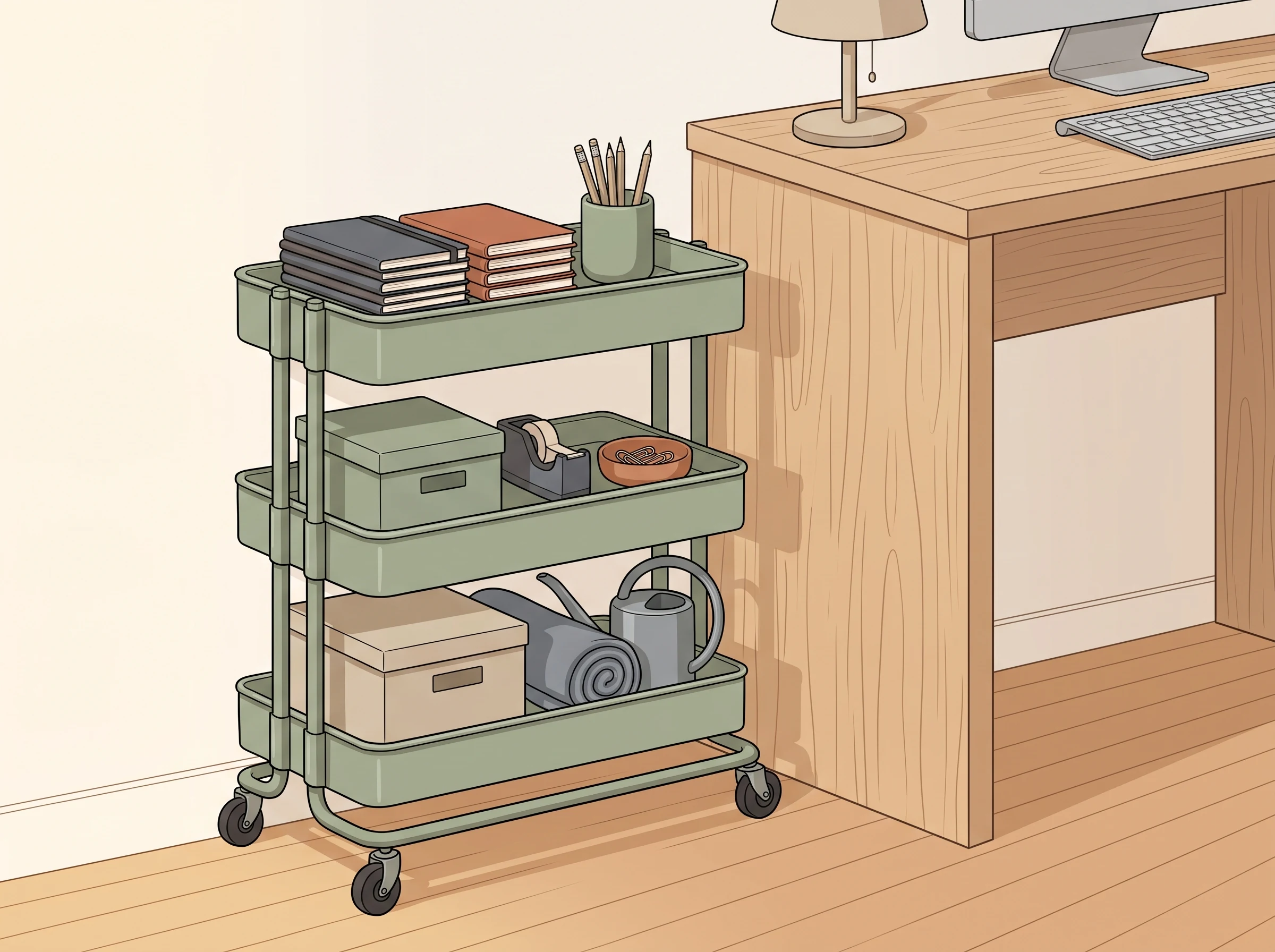
A rolling cart can create storage without committing one wall or one room permanently.
The same cart might serve as:
- bathroom storage,
- kitchen overflow,
- office supplies,
- bedside storage, and
- craft storage.
Small-apartment storage guidance frequently recommends tiered carts because they add usable storage while remaining movable between rooms.
Product slot
Compact rolling cart
Best for
Renters whose storage needs may change from room to room.
Consider
Measure both:
- cart footprint, and
- remaining walkway.
Mobility does not help if the cart permanently blocks circulation.
5. Use Removable Adhesive Storage Selectively
Adhesive storage can be useful for lightweight items when the product is appropriate for the specific surface.
Possible uses include:
- small caddies,
- hooks,
- lightweight organizers, and
- cord management.
Renter-focused organizing guidance commonly includes removable adhesive systems as alternatives to drilling.
Product slot
Removable adhesive organizer
Research carefully
Verify:
- compatible surfaces,
- installation instructions,
- intended load, and
- removal instructions.
Important
“No drilling” does not guarantee:
- no paint damage,
- compatibility with every wall, or
- unlimited load capacity.
Follow the manufacturer’s instructions and consider your lease and wall finish.
6. Use Existing Furniture More Efficiently
Sometimes the apartment does not need another storage product.
Existing furniture simply needs better internal organization.
Examples:
- shelf risers,
- drawer dividers,
- small bins,
- stackable containers, and
- baskets.
Small-space organization guidance emphasizes internal organizers because they can increase usability without increasing the furniture footprint.
Product slot
Shelf riser or internal organizer
Best for
- kitchen cabinets,
- bathroom shelving,
- desk storage, and
- closets.
Why it is especially renter-friendly
You improve storage capacity without modifying the building at all.
7. Use Magnetic Storage Where the Surface Allows It
Some metal surfaces can become storage surfaces without drilling.
Possible examples include:
- refrigerator sides,
- metal utility cabinets, and
- other suitable magnetic surfaces.
Recent small-space design guidance includes magnetic storage as a renter-friendly way to use otherwise empty vertical surfaces, particularly in kitchens.
Product slot
Magnetic storage rack
Possible uses
- spices,
- paper towels,
- lightweight kitchen supplies, and
- small household items.
Consider
Verify:
- actual magnetic compatibility,
- intended load, and
- whether the storage interferes with appliance ventilation, doors, or controls.
Do not assume every metal-looking surface is magnetic.
8. Choose Furniture With Hidden Storage
If you already need a:
- bench,
- ottoman,
- coffee table, or
- bedside table,
consider whether the same footprint can provide storage.
Small-apartment organizing guidance consistently recommends multifunction furniture because it can combine storage with another necessary function.
Product slot
Storage ottoman or storage bench
Best for
- blankets,
- bags,
- books, and
- occasional items.
Ask before buying
Does the product genuinely replace two useful pieces?
Or does it simply advertise a small storage cavity as an extra feature?
Multifunction furniture is only space-efficient when both functions matter.
No-Drill Storage by Room
Bedroom
Start with:
- under-bed containers,
- over-door storage, and
- low freestanding furniture.
Bathroom
Consider:
- rolling carts,
- removable caddies, and
- over-door hooks.
Kitchen
Consider:
- shelf risers,
- magnetic storage, and
- rolling carts.
Home Office
Consider:
- freestanding drawer units,
- desktop organizers, and
- cable management.
Entryway
Consider:
- storage bench,
- over-door storage, and
- compact freestanding organizer.
What to Check Before Choosing a “Renter-Friendly” Product
The label itself is not enough.
Ask:
Does it attach to the building?
If yes, how?
Is the surface compatible?
Especially for adhesives and suction systems.
What does the manufacturer require?
Follow installation and stability instructions.
Could removal affect the finish?
Consider paint, wallpaper, cabinetry, tile, or other surfaces.
Does the lease restrict the installation?
Check if uncertain.
Will the product move with you?
Portable storage can be especially useful if your next apartment has a different layout.
Product Opportunities for This Guide
For the lean affiliate version, research one product for each of these strong slots:
- Compact freestanding storage
- Over-the-door organizer
- Under-bed storage
- Rolling cart
- Removable adhesive organizer
- Shelf riser / internal organizer
- Magnetic storage rack
- Storage ottoman or bench
You do not need all eight.
A finished article with five or six strong recommendations will usually read better than one with a product after every paragraph.
What This Guide Is Not Saying
This article is not suggesting that renters should avoid every wall attachment.
Some storage products need secure installation to function safely.
For example, IKEA’s own vertical wall-storage products specify secure anchoring and appropriate wall fasteners, and CPSC continues to warn about furniture tip-over hazards.
If a product requires anchoring:
follow the manufacturer’s instructions and resolve any lease question with the property owner or manager.
Safety should take priority over maintaining a strictly “no holes ever” rule.
The Bottom Line
The easiest way to add renter-friendly storage is often to begin with the parts of the apartment that already exist:
- doors,
- under-bed space,
- cabinet interiors,
- furniture surfaces,
- metal appliance sides, and
- unused floor corners.
Use freestanding and removable storage where it makes sense.
Reserve permanent installation for situations where it is necessary, permitted, and done correctly.
That gives you a storage system that can work in the apartment you have now—and remain useful in the next one.
Relevant options
Product considerations
These are practical product types to evaluate against your measurements and installation limits.
Over-door organizer
Over-door organizer
May work well for:Comparing options for no drilling allowed
- Useful when
- No drilling allowed
- Consider
- Confirm door thickness top clearance and door swing
Potential benefits
- Relevant product category
- Retailer destination available
Slim rolling cart
Slim rolling cart
May work well for:Comparing options for no drilling allowed
- Useful when
- No drilling allowed
- Consider
- Confirm gap width walkway clearance and wheel path
Potential benefits
- Relevant product category
- Retailer destination available
Removable wall hooks
Removable wall hooks
May work well for:Comparing options for no drilling allowed
- Useful when
- No drilling allowed
- Consider
- Confirm surface compatibility removal instructions and load limit
Potential benefits
- Relevant product category
- Retailer destination available
Compact storage ottoman
Compact storage ottoman
May work well for:Comparing options for no drilling allowed
- Useful when
- No drilling allowed
- Consider
- Confirm exterior footprint seating rating and storage capacity
Potential benefits
- Relevant product category
- Retailer destination available